Why Is Custom Furniture So Difficult to Sell Online?
Custom furniture gives shoppers more choice, but those choices create complexity. Selling it online requires brands to manage product rules, visualization, dimensions, pricing, and ordering in a way that is both accurate and easy for customers to understand.
Buying a standard product online is relatively straightforward.
There is one product. It has a price. The customer chooses a quantity, adds it to a cart, and checks out.
Custom furniture doesn't work like that.
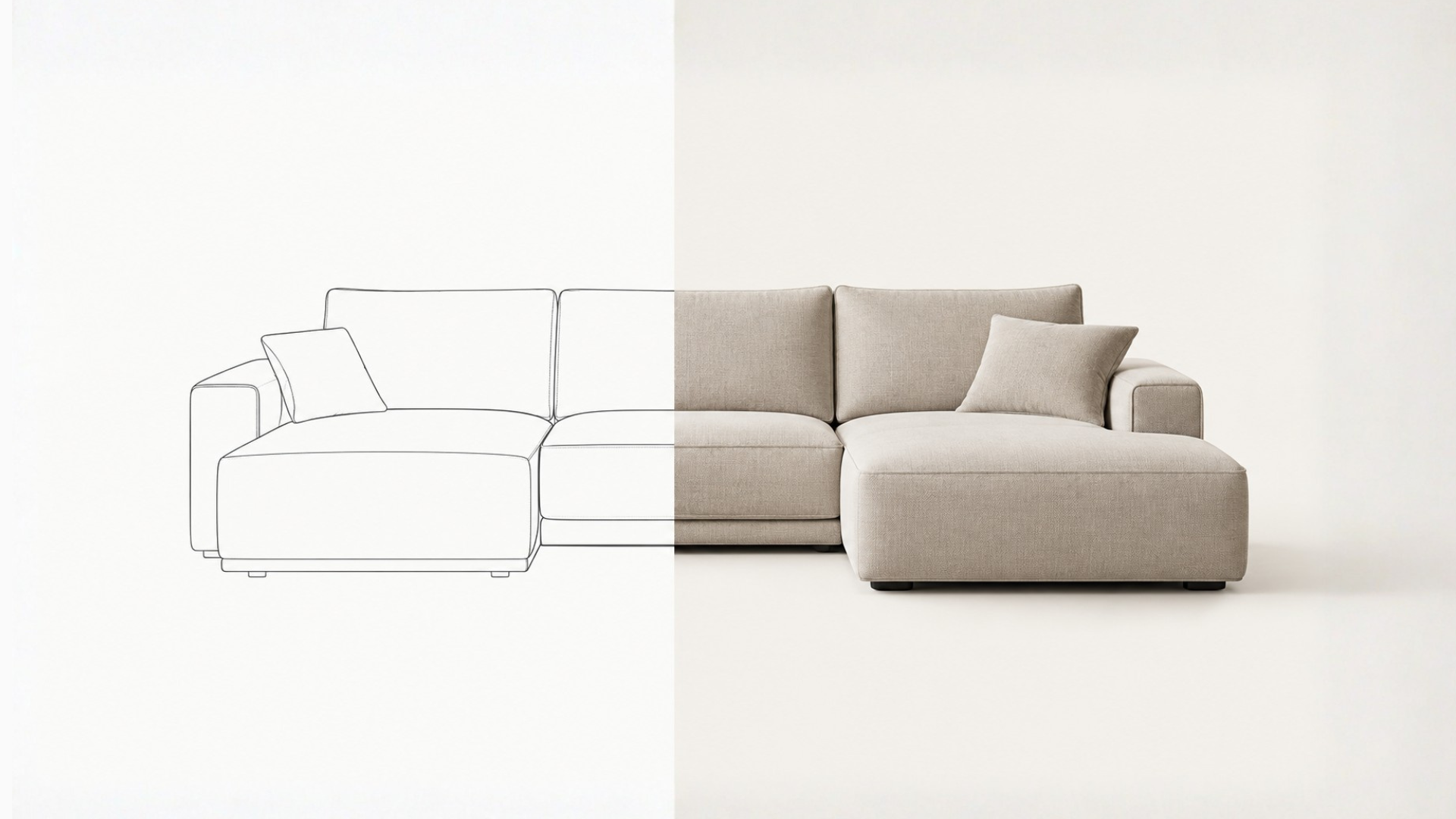
A single sofa can have multiple sizes, configurations, arms, cushions, bases, finishes, fabrics, leathers, and other options. Some combinations work together. Others don't. Every decision can affect what the finished product looks like, how large it is, and how much it costs.
That creates a challenge furniture manufacturers have been dealing with for years:
How do you give customers the freedom to customize furniture without making the buying process overwhelmingly complicated?
The answer starts with understanding where that complexity comes from.
Why does custom furniture become so complex online?
The problem isn't simply that custom furniture has "a lot of options."
Those options are connected.
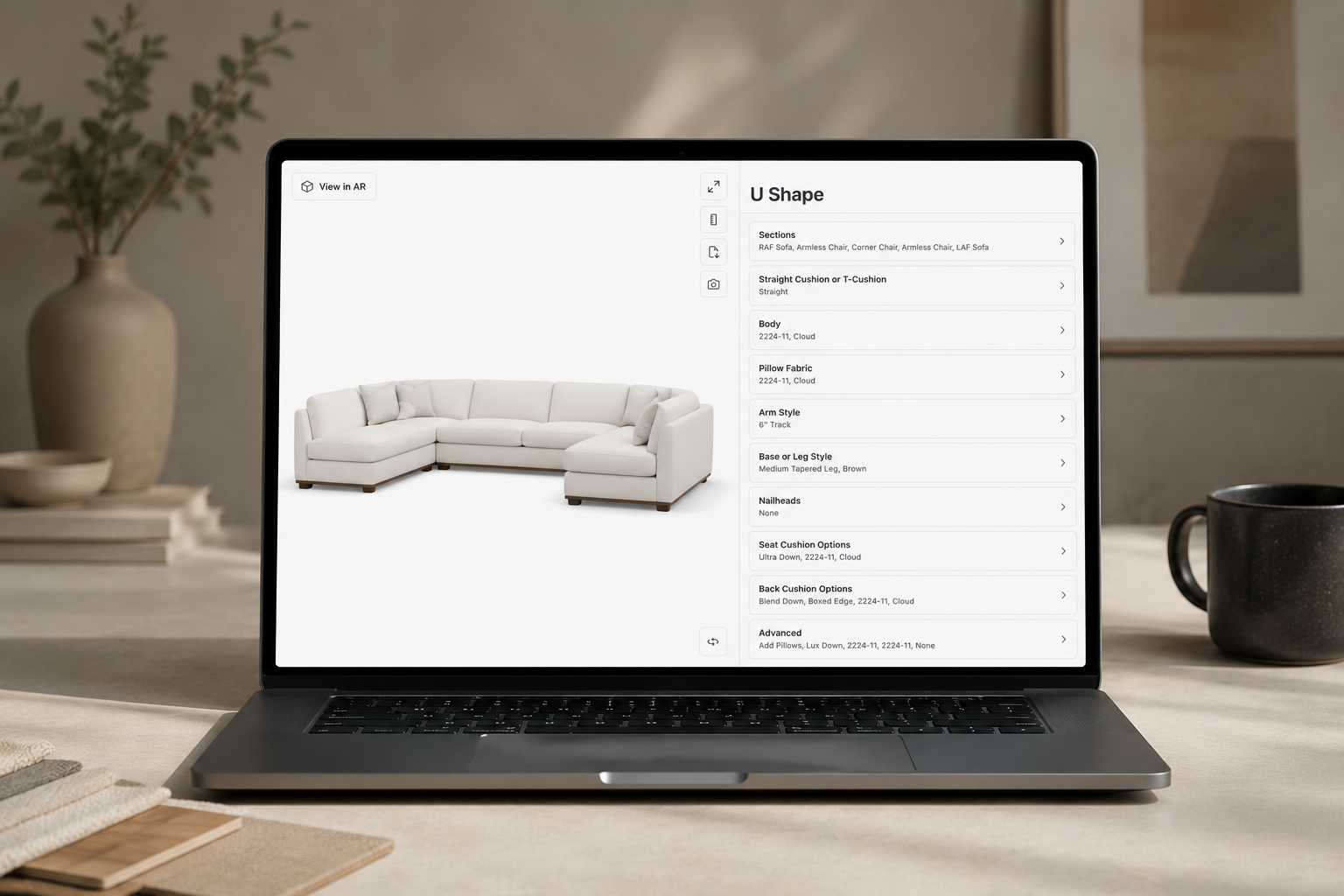
Imagine a shopper configuring a sectional. They might need to choose:
- the pieces that make up the sectional,
- the orientation and layout,
- upholstery,
- cushion options,
- arm style,
- base or leg finish,
- and additional product-specific options.
Changing one selection may affect another.
A particular component may only be compatible with certain configurations. A fabric may belong to a different price grade. Adding another sectional piece changes the overall dimensions and price.
So an online system can't simply display every option independently.
It needs to understand how the product actually works.
That distinction is important. Custom furniture isn't just a catalog of SKUs. It is a set of products, options, rules, and relationships that have to remain accurate as the customer makes decisions.
How can shoppers understand what they're creating?
Once customers can make all of those choices, another problem appears:
They need to see the result.
A small fabric swatch doesn't necessarily tell someone what an entire sectional will look like in that material. A diagram of individual sectional pieces doesn't show what those pieces look like assembled together.
This is where 3D product visualization becomes particularly useful for configurable furniture.
Instead of asking customers to imagine the result, a 3D configurator can update the product as selections are made.
Change the fabric. The visualization changes.
Choose a different configuration. The model changes.
Select another finish. The customer sees the new combination.
The experience turns customization from a list of abstract selections into something the customer can actually explore.
How do you stop customers from creating impossible configurations?
Visualization alone isn't enough.
A configurator also needs to know which combinations can actually be manufactured.
If two sectional components can't be connected, the customer shouldn't be able to create that combination. If one option makes another unavailable, the interface needs to respond accordingly.
These product rules are especially important for manufacturers with large configurable catalogs.
Without them, the digital experience can create configurations that look valid to a customer but aren't valid when the order reaches the manufacturer.
A useful configuration system therefore does two jobs simultaneously:
It gives the customer freedom while keeping that freedom within the rules of the product.
How do you show accurate dimensions as a furniture configuration changes?
Dimensions are another challenge because custom furniture doesn't necessarily have one fixed size.
Add another sectional component and the overall width changes.
Change the configuration and the footprint changes.
That matters when customers are deciding whether a piece will fit through a room, against a wall, or within a specific floor plan.
For configurable products, measurements therefore need to respond to the configuration itself.
Dynamic measurements can show customers the dimensions of the furniture they have actually created rather than forcing them to piece together measurements from individual components.
This becomes even more valuable when visualization extends beyond the product page.
Placing a configured product into a room scene or spatial planning tool gives customers another way to understand scale before making a purchase.
Why is pricing custom furniture so difficult?
Pricing can be one of the most complicated parts of selling configurable furniture.
The final price may depend on:
- the selected product configuration,
- the number and type of components,
- fabric or leather grade,
- finishes and options,
- manufacturer pricing rules,
- retailer or dealer programs,
- and different pricing tiers.
That means a price can't always be attached to a product before configuration begins.
It has to be calculated from the configuration.
And in dealer-based furniture sales, there can be another layer of complexity: different retailers may operate under different pricing programs.
This is why configuration and pricing work best when they aren't treated as separate processes. Once a customer or sales associate has created a valid configuration, the pricing system needs to understand exactly what was selected and apply the correct rules to it.
Why do large furniture catalogs make the problem harder?
Everything we've described becomes more difficult at scale.
A manufacturer might have hundreds of collections, thousands of products, enormous material libraries, and countless possible combinations.
Maintaining that information manually across websites, retailer tools, price lists, catalogs, and sales materials creates opportunities for inconsistencies.
It also makes updating information difficult.
Change a fabric.
Update a price.
Introduce a new sectional component.
Discontinue an option.
That change may need to appear everywhere the product is sold or represented.
For large furniture brands, the challenge therefore isn't only creating a good configurator. It's creating a digital product system capable of supporting the catalog behind it.
What does a good online custom furniture experience need?
There isn't one interface that works for every furniture manufacturer, but the underlying requirements are remarkably consistent.
A strong custom furniture experience needs to:
- Understand the product. The system needs to know available options, components, and compatibility rules.
- Show the result. Customers should be able to visualize what they're creating rather than imagining it from text and swatches.
- Keep configurations valid. Impossible combinations should be prevented automatically.
- Update measurements. Dimensions should reflect the actual configuration where product size can change.
- Connect configuration with pricing. The price or quote should be based on the customer's actual selections and applicable pricing rules.
- Handle catalog complexity at scale. The experience needs to remain manageable as products, materials, prices, and options change.
- Give the configuration somewhere to go. A finished configuration should be usable by the retailer, salesperson, quoting process, or other systems involved in completing the sale.
The interface customers see is only the final layer.
The real challenge is connecting everything underneath it.
Can custom furniture actually be sold well online?
Yes — but trying to force custom furniture into an eCommerce experience designed for simple products creates problems quickly.
The digital experience has to reflect the way furniture is actually manufactured and sold.
That means connecting product data, configuration rules, visualization, measurements, materials, and pricing rather than treating each as a separate feature.
When those pieces work together, complexity doesn't have to disappear.
It becomes manageable.
And that's ultimately the goal: not to remove the choices that make custom furniture valuable, but to make those choices easier for customers and retailers to understand.


Related posts
Interested in our solutions?