How Can AI Help Furniture Retailers Sell More?
AI can do more for furniture retail than write product descriptions or answer customer questions. From helping shoppers visualize products in their own homes to simplifying complex quotes, here are some of the ways AI can help furniture retailers turn more interest into sales.

Buying furniture comes with a lot of uncertainty.
Will this sectional fit?
Will that fabric work in my room?
What would the sofa look like against my wall color?
How much will this exact configuration cost?
Can I see another option?
For a salesperson in a showroom, answering those questions can take time. For a customer shopping online, not getting an answer can be enough to stop the purchase altogether.
This is where some of the most interesting applications of AI in furniture retail are emerging.
The opportunity isn't simply to automate more of the sales process. It's to give shoppers — and the people selling to them — better tools to make decisions.
1. Help Customers See Furniture in Their Own Space
One of the biggest challenges in furniture retail is remarkably simple:
Customers have to imagine.
They see a sofa in a showroom or online, but they need to picture it in a completely different room.
AI-powered room visualization can reduce that gap.
Instead of relying only on staged room photography, retailers can start with a photo of the customer's actual room. Existing furniture can be removed, new pieces introduced, and the room transformed into a more polished visualization.
But there's an important distinction between AI inspiration and AI-assisted selling.
An AI-generated room full of imaginary furniture may be useful for inspiration. It doesn't necessarily help a retailer close the sale.
For retail, the more valuable experience is one built around products the customer can actually buy.
Snap Design by Intiaro combines AI room visualization with real products from a manufacturer's digital catalog. A retailer or designer can upload a customer's room, remove existing furniture, place configurable products into the space, adjust finishes and fabrics, and create a realistic visualization.
The result isn't simply an AI-generated idea.
It's a room built around the products being sold.
2. Make Customization Easier to Understand
Customization is one of furniture's biggest strengths — and one of its biggest sales challenges.
A customer may love a sofa but dislike the fabric shown on the floor.
There might be hundreds of alternatives.
Explaining all of them verbally isn't particularly helpful.
Digital configuration allows customers and salespeople to see those choices rather than imagine them.
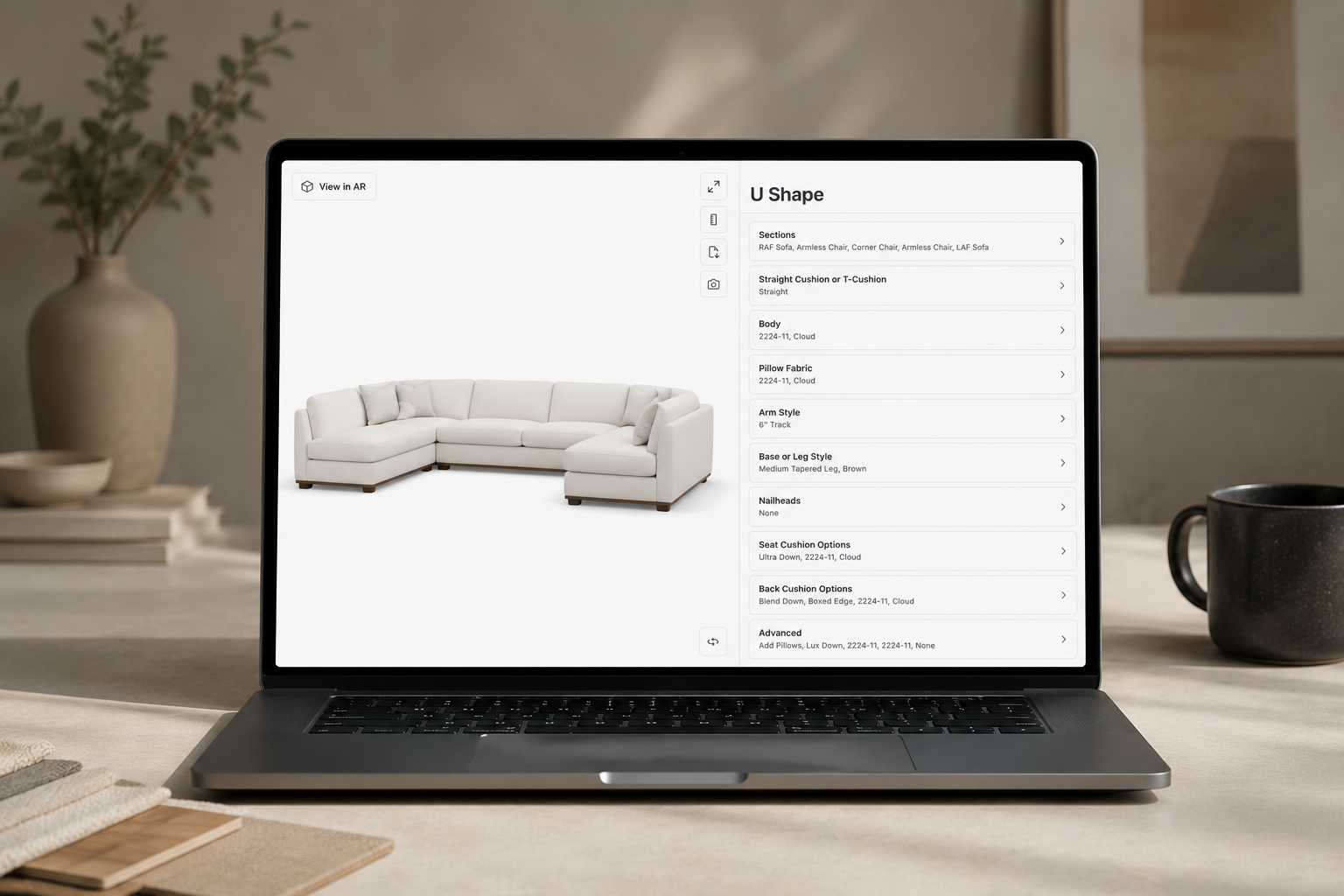
With a 3D furniture configurator, a shopper can explore fabrics, finishes, components and other available options while seeing the product update as selections change.
For highly configurable furniture, the technology can also ensure that the options being shown actually work together.
Intiaro's 3D Configurator is built specifically around furniture products and their configuration logic, allowing manufacturers and their retailers to turn complex catalogs into interactive selling experiences.
AI can make that experience increasingly conversational and intuitive, but the underlying product data and configuration rules remain essential.
After all, an AI assistant isn't particularly useful if it confidently recommends a combination the manufacturer cannot build.
3. Turn a Complicated Sectional Into a Visual Conversation
Sectionals take the customization problem even further.
A shopper might know roughly what they want:
"I need an L-shaped sectional for this corner, probably in a lighter performance fabric."
Turning that request into an actual order is another matter.
Which pieces connect?
Which arm goes where?
How large will the finished sectional be?
Does the selected configuration actually exist?
How much does it cost?
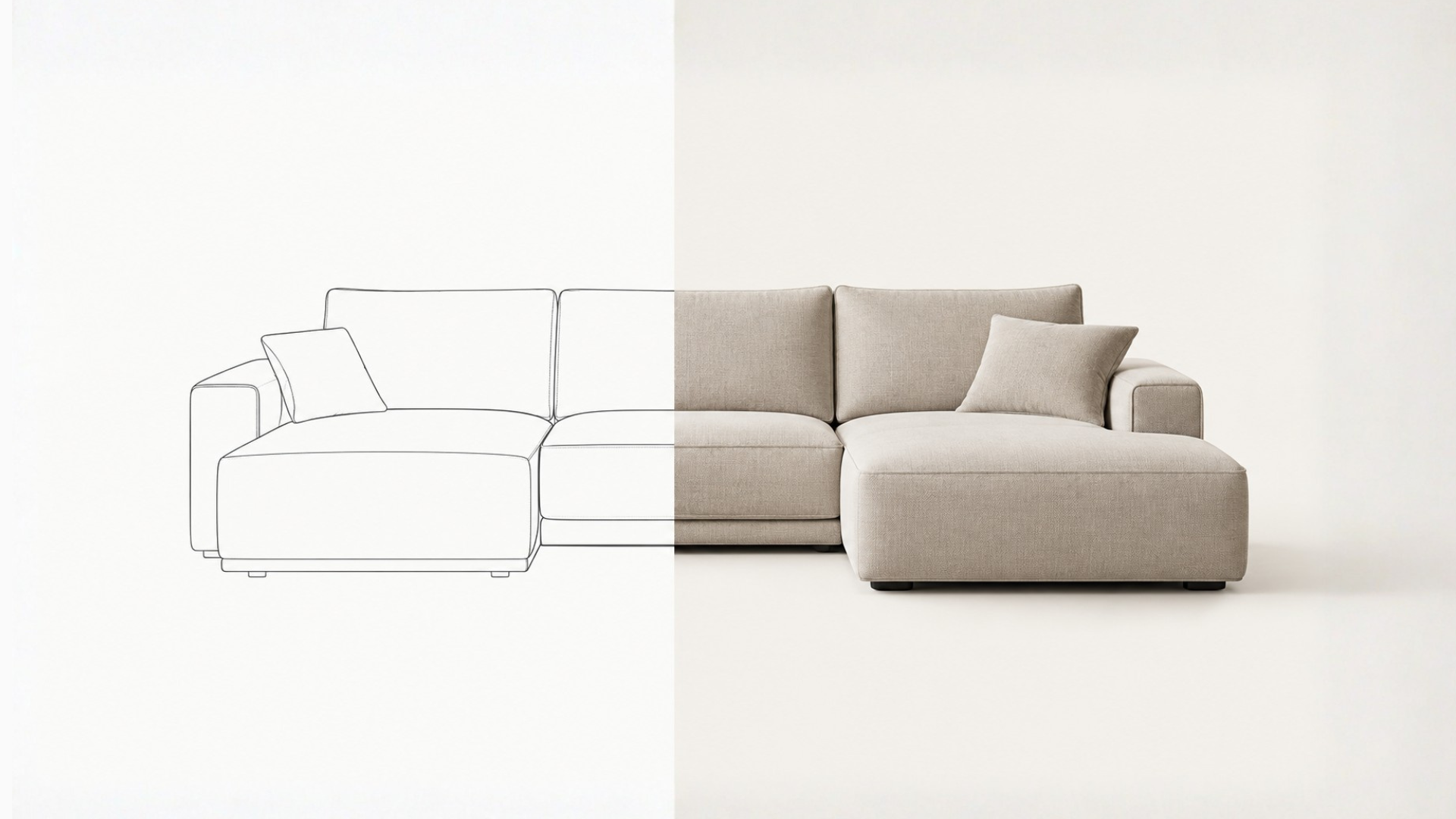
Tools such as Intiaro's Sectional Builder make those decisions visual. Compatible components can be assembled into a valid configuration while the customer sees the sectional take shape.
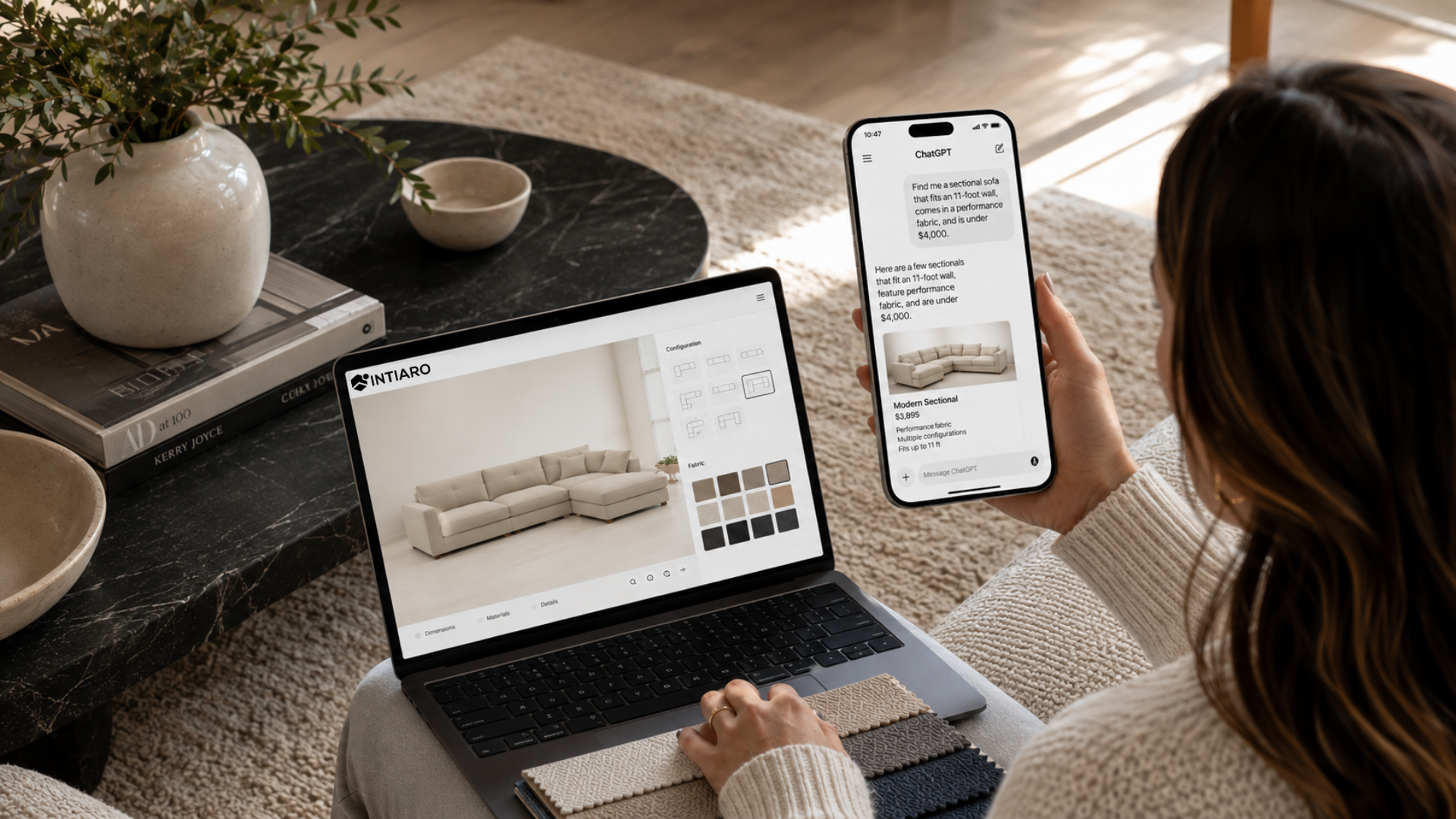
AI can add another layer by helping interpret what the shopper is trying to achieve, while structured configuration technology makes sure the result corresponds to something that can actually be manufactured and sold.
That's an important distinction.
AI can understand intent. Product configuration technology understands the product.
Furniture retail increasingly needs both.
4. Make Complex Pricing Faster
Even after a customer has chosen the product, another problem can appear:
What does this exact configuration cost?
Furniture pricing can become complicated quickly.
Different fabrics can change the price. Options can add premiums. Retailers may operate under different programs or pricing tiers. A configured sectional can contain multiple components, each affecting the final quote.
For sales teams, getting from configuration to an accurate price can involve spreadsheets, price lists, emails or calls back to the manufacturer.
AI can help simplify that process.
AI CPQ powered by Intiaro is designed specifically for complex furniture pricing. It helps manufacturers manage retailer programs and pricing centrally while giving authorized retailers access to the pricing that applies to them.
Instead of making the salesperson navigate the complexity behind the price, the technology handles more of that complexity in the background.
That means less time finding a number — and more time actually selling.
5. Help Salespeople Respond Faster
Not every use of AI needs to be customer-facing.
Some of its biggest benefits may happen behind the scenes.
Furniture salespeople spend time searching catalogs, checking specifications, comparing products, finding dimensions, confirming options and preparing information for customers.
When that information is structured and accessible, AI can make it much faster to retrieve.
A salesperson could eventually move from searching through multiple resources to asking questions such as:
"Which of our sofas are available under 90 inches in a performance fabric?"
"What sectional configuration would work on a 120-inch wall?"
"What's the price of this configuration for this dealer?"
The quality of those answers, however, depends heavily on the quality of the underlying product information.
AI doesn't eliminate the need for good product data.
It makes good product data more valuable.
6. Create More Personalized Selling Experiences
Furniture purchases are highly personal.
Two people shopping for a sofa may care about completely different things.
One has a small apartment.
Another has three children and a dog.
Another is furnishing a hospitality project.
Another simply wants something that looks like the sofa they saved on Pinterest.
AI can help retailers respond to those differences more efficiently by narrowing large catalogs around what a particular customer actually needs.
Combined with product configuration and visualization, that creates a very different shopping experience.
Instead of:
browse → filter → scroll → imagine
the experience can become:
describe → discover → configure → visualize → price
That's a much shorter distance between “I think I like this” and “Yes, that's the one.”
Will AI Replace Furniture Salespeople?
Probably not — and that's arguably the wrong question.
Furniture is tactile, emotional and often expensive. Customers still benefit from expertise, reassurance and human judgment, particularly when they're making a significant purchase or configuring something complex.
The more interesting role for AI is as a sales tool.
It can remove some of the friction surrounding the salesperson:
less searching, less manual quoting, less explaining what a product might look like and less asking customers to imagine.
That leaves more room for the parts of furniture selling that humans are particularly good at — understanding the customer, providing expertise and helping them make a decision they feel confident about.
What Should Furniture Retailers Do With AI Today?
Retailers don't need to add AI everywhere simply because it's available.
Start with the moments where customers hesitate or salespeople lose time.
Where are shoppers being asked to imagine something they could see?
Where is product complexity difficult to explain?
Where does a salesperson need to leave the conversation to find information?
Where does quoting take longer than it should?
Where does a customer have hundreds of choices but little help narrowing them down?
Those are the places where AI and better digital product technology can have a measurable impact.
For furniture retailers, the future of AI may not be a robot salesperson.
It may simply be a much better-equipped human one.
And when visualization, configuration, product data and pricing work together, both the salesperson and the customer can get to the most important answer faster:
Yes, this is the right piece.

Related posts
Interested in our solutions?