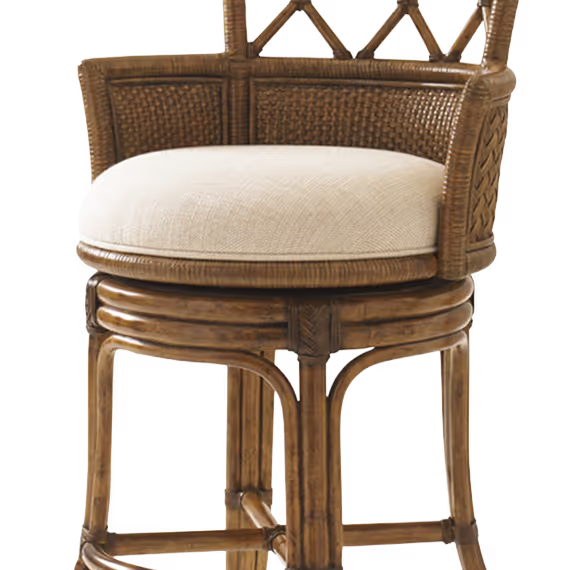
3D Furniture Configurators: What Manufacturers Need to Know
3D furniture configurators do more than let customers change a fabric or finish. For manufacturers, the right platform can connect visualization, product rules, pricing, specifications and sales tools — while turning your 3D catalog into a digital asset your business can continue to use.
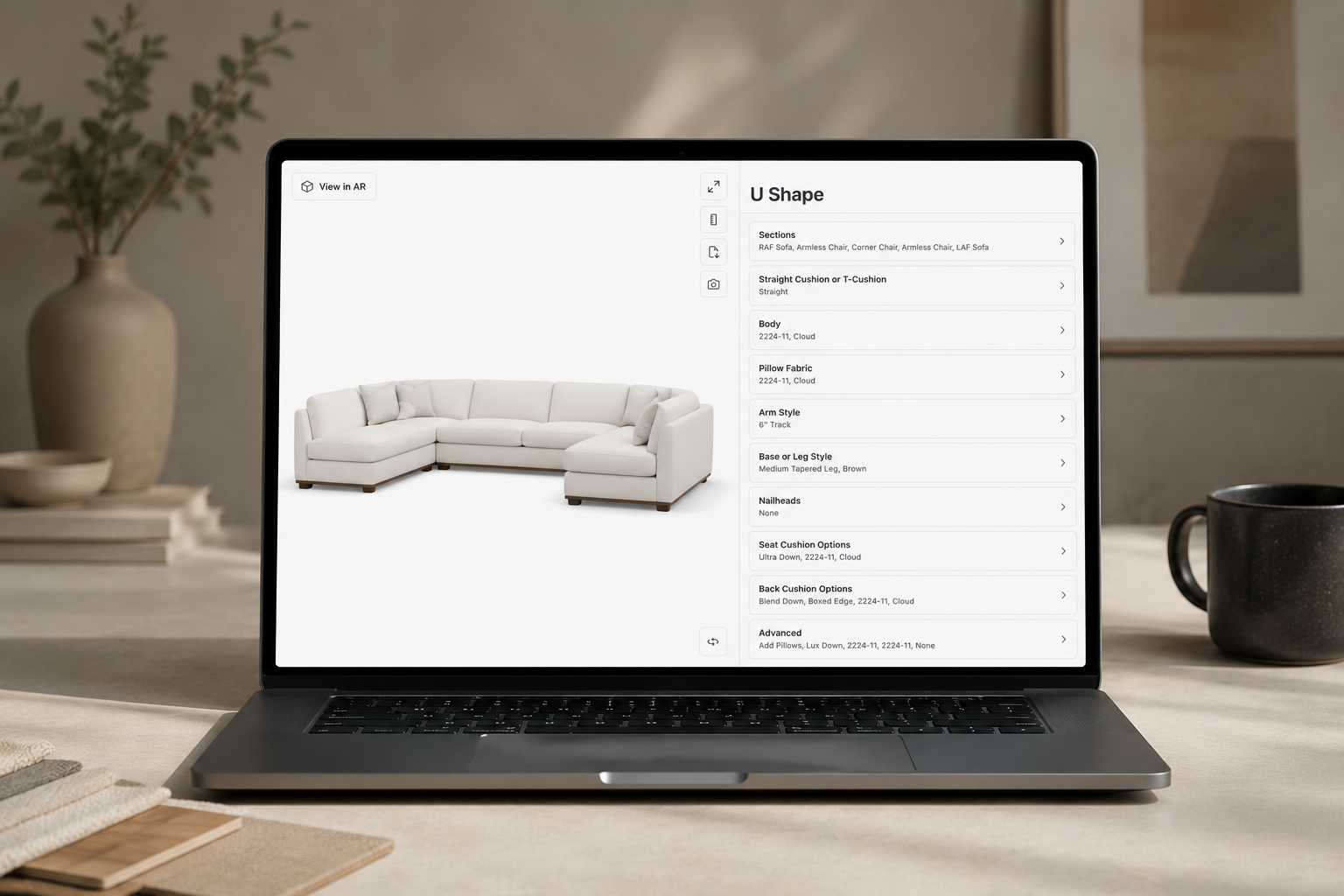
Furniture is rarely as simple as it looks.
A sofa may come in hundreds of fabrics, multiple sizes, different arm styles, leg finishes, cushion options and configurations. A sectional can have thousands of valid combinations. Add dimensions, pricing, SKUs and retailer-specific programs, and suddenly a traditional product page has a lot of information to communicate.
A 3D furniture configurator gives customers, designers, retailers and sales teams a way to navigate that complexity visually.
Instead of imagining what a sofa might look like in a different fabric or trying to understand a sectional from a specification sheet, users can build the product they want and see their selections in real time.
For furniture manufacturers, however, a configurator can do much more than change colors on a 3D model. The right system can connect product visualization with configuration rules, product data, pricing and sales tools — creating a digital representation of the way products are actually sold.
What Is a 3D Furniture Configurator?
A 3D furniture configurator is an interactive digital tool that allows a user to customize a furniture product while viewing the result in 3D.
Depending on the product, users might be able to change:
- Fabric or leather
- Wood and metal finishes
- Size
- Arms
- Bases and legs
- Cushions
- Hardware
- Sectional components
- Layout
- Other product-specific options
As selections are made, the 3D product updates to represent the chosen configuration.
This is particularly valuable for furniture because manufacturers often sell far more variations than they could realistically photograph.
A single chair offered in 100 fabrics, five wood finishes and three base options already represents 1,500 possible combinations. With modular sectionals and highly customizable upholstery, the number can become dramatically larger.
A 3D configurator makes those possibilities visible without requiring photography of every combination.
How Does a 3D Furniture Configurator Work?
At its simplest, a furniture configurator combines a digital 3D model with the options and rules that define a product.
But furniture configuration is more complex than simply applying different colors or materials to a model.
The system needs to understand how the product itself works.
For example, a sectional collection might include left-arm, right-arm, armless, corner and chaise components. Certain pieces can connect while others cannot. Different configurations have different overall dimensions, SKUs and prices.
The configurator needs to understand those relationships.
Several layers work together to make that possible:
3D geometry represents the shape and construction of the furniture.
Materials and textures recreate fabrics, leathers, woods, metals and other finishes.
Configuration rules determine which options and components can be combined.
Product data connects configurations with information such as dimensions, SKUs and specifications.
Pricing data, when integrated, can calculate the appropriate price for a selected configuration.
The result is not simply a picture of a sofa. It is an interactive digital representation of a configurable product.
Why Is Furniture Configuration So Complex?
Many industries sell configurable products, but furniture presents a particular combination of visual and structural complexity.
Consider an upholstered sofa.
The customer may need to choose a frame, size, fabric, finish, cushion, arm and base. A designer may want to specify a Customer's Own Material (COM). A retailer may need the exact SKU, dimensions and price for that particular combination.
Now consider a sectional.
The user is no longer selecting options for one object. They are assembling multiple pieces into a valid layout while dimensions and other product information change with the configuration.
And every manufacturer has its own rules.
That is why a furniture configurator needs to understand more than what a product looks like. It needs to understand how that manufacturer allows the product to be configured and sold.
What Can Customers Configure?
The answer depends entirely on the manufacturer's product offering.
For relatively simple products, configuration might involve selecting a material and finish. For highly configurable furniture, users may be able to customize almost every visible element of the product.
Fabrics and Leathers
Upholstery is one of the most common uses of 3D furniture configuration.
Instead of looking at a small swatch next to a generic product image, customers can see the selected textile applied to the complete piece of furniture.
This becomes especially useful for manufacturers offering hundreds or thousands of upholstery options.
Finishes and Product Options
Wood stains, painted finishes, metals and other materials can be visualized directly on the product.
Depending on the collection, users may also be able to change arms, backs, cushions, bases, legs, nailheads, hardware and other details.
Instead of relying entirely on option codes and specification sheets, the buyer can see those choices.
Sectional Layouts
Sectional furniture adds another level of complexity.
A sectional builder can allow users to add, remove and rearrange compatible components while maintaining the rules defined by the manufacturer.
Dimensions can update as the configuration changes, helping the customer understand not only what the sectional looks like but whether the finished configuration will fit their space.
3D Furniture Configurator vs. 360 Viewer
A 360-degree viewer and a 3D configurator are often grouped together, but they solve different problems.
A 360 viewer allows the user to rotate a product and examine it from different angles.
A 3D furniture configurator allows the user to change the product itself.
If a chair only comes in one version, a 360 viewer may be enough to give customers a better understanding of it.
If that chair comes in hundreds of fabrics, multiple finishes, bases and other options, configuration becomes much more valuable.
Put simply:
A 360 viewer helps customers explore a product. A configurator helps them create their version of it.
3D Furniture Configurator vs. Room Planner
A furniture configurator and a room planner also serve different purposes.
A configurator focuses primarily on the product.
A room planner focuses primarily on the space.
With a configurator, the question is:
What should this sofa, chair, table or sectional look like?
With a room planner, the question becomes:
How will these products work together in this room?
The technologies can also complement one another. A customer might configure a sofa first and then use that exact product in another visualization experience to understand how it works within a space.
That is one reason the 3D assets behind a configurator can become particularly valuable.
What Should Furniture Manufacturers Look for in a 3D Configurator?
Not all configurators are built for the same level of complexity.
Manufacturers should evaluate more than the visual quality of a demo.
Support for Your Actual Product Complexity
Start with the products themselves.
Can the system represent all the options you currently sell?
If you offer hundreds of fabrics, complex sectional rules, dynamic dimensions, COM, multiple finishes or non-visual options, those requirements should be considered from the beginning.
A beautiful configurator that represents only part of your catalog does not solve the underlying problem.
Realistic Material Visualization
Furniture purchases are highly visual, and materials matter.
A velvet, boucle, patterned textile and leather should not simply appear as different colors on the same surface.
Texture, pattern scale, material properties and detail all contribute to whether the digital product feels believable.
For upholstery manufacturers in particular, material visualization should be an important part of evaluating any 3D platform.
Accurate Configuration Rules
Users should not be able to create products the manufacturer cannot produce.
The configurator needs to understand which combinations are valid and which are not.
This becomes particularly important with modular furniture, where individual components have specific compatibility rules.
Dynamic Dimensions
For furniture, dimensions are essential.
A sectional may become wider every time another component is added. Changing an arm or component may affect the overall footprint.
Displaying dimensions dynamically can help users understand whether a configuration works for their space without manually calculating measurements.
Sectional Building
If sectionals are an important part of your catalog, sectional functionality should be evaluated specifically.
Building a sectional is fundamentally different from changing the upholstery on a sofa.
The system needs to understand how pieces connect, which components are compatible and how the complete configuration changes as pieces are added, removed or rearranged.
Pricing Capabilities
For many manufacturers and retailers, visualization is only one part of the sales process.
The next question is often simple:
How much does this exact configuration cost?
The answer may not be simple at all.
Furniture pricing can depend on fabric grade, components, finishes, size and other selected options. Dealer networks add another layer, with different retailers potentially operating under different programs, multipliers or pricing structures.
Connecting configuration with pricing allows the system to calculate the appropriate price based on what has actually been built.
Sales and Designer Tools
Consider who will use the configurator.
It may be a consumer shopping online, but it could also be a salesperson in a showroom, a dealer or an interior designer.
Those users may need more than visualization.
They may need dimensions, product information, a tear sheet, a downloadable image or a 3D model that can be used within their design workflow.
A configurator becomes significantly more valuable when it supports the processes surrounding the sale rather than functioning as an isolated website feature.
Integration and Distribution
Manufacturers should also consider where their digital product experience needs to live.
Is the configurator only going to appear on the manufacturer's website?
Or should the same product information and visualization reach retailers, dealers, designers and other digital channels?
The more often product information has to be recreated manually, the greater the opportunity for outdated visuals, incorrect options and inconsistent information.
A centralized digital product catalog can make it easier to keep those experiences aligned as collections change.
Can a 3D Furniture Configurator Show Pricing?
Yes — but furniture pricing can be considerably more complex than attaching a price to each product.
The price of a configured product may depend on the selected fabric grade, components, finishes, size and other options.
Dealer networks introduce another level of complexity. Different retailers may operate under different pricing programs, while manufacturers need to make current pricing available without losing control over how it is distributed.
This is where Configure, Price, Quote (CPQ) technology becomes particularly relevant.
Connecting product configuration with pricing means the system already knows what the user has built. Instead of recreating the configuration elsewhere to determine its price, pricing can be calculated from those same selections.
For complex furniture sales, bringing visualization and pricing together can remove significant friction from the quoting process.
Can the Same 3D Furniture Models Be Used Elsewhere?
Yes — and this is an important consideration when evaluating the investment required to create a 3D catalog.
A structured 3D product library can support much more than a single configurator.
Depending on the platform and available integrations, the same assets can support:
- 360-degree product visualization
- High-resolution product imagery
- Room scenes
- Augmented reality
- Designer tools
- Retailer experiences
- 3D downloads
- Product tear sheets
- Ecommerce
- Marketing content
This changes the economics of creating 3D content, particularly when the manufacturer owns the assets being created.
Instead of thinking about the cost of creating a model for one website feature, manufacturers can think about building a reusable digital product asset that can support multiple stages of the furniture buying journey.
Who Owns the 3D Models?
This is one of the most important questions manufacturers should ask when choosing a 3D furniture configurator or visualization provider.
Creating a digital 3D catalog is an investment.
If those models can support ecommerce, product imagery, room scenes, augmented reality, designer workflows, retailer experiences and future applications, their value extends far beyond the configurator where they were first used.
Manufacturers should therefore understand from the beginning who owns the 3D models being created and what they are allowed to do with them.
With Intiaro, the manufacturer owns the 3D models created for its products.
Your 3D catalog is not simply content that exists inside the Intiaro platform. The models are digital assets belonging to your business.
That distinction becomes increasingly important as 3D is used across more of the furniture sales and marketing ecosystem.
When comparing 3D furniture configurator providers, manufacturers should ask:
- Who owns the finished 3D models?
- Can we use those models outside the configurator?
- Can they support other sales and marketing applications?
- Are there restrictions on how the assets can be used?
- What happens to our models if we change technology providers in the future?
A configurator is one application. The 3D models behind it can be long-term digital assets — and manufacturers should know exactly what they own.
Is a 3D Furniture Configurator Worth It?
For a product with very few options, a full 3D configurator may not always be necessary.
But as product complexity increases, traditional ecommerce experiences become increasingly difficult to manage.
Static photography can only show a fraction of the available combinations. Swatches require customers to imagine the finished product. Complex specification documents put more work on dealers, designers and sales teams.
A 3D configurator gives those users a way to interact with the manufacturer's actual product offering visually.
For manufacturers, the larger opportunity comes from connecting that visualization with the information and systems surrounding the product.
The question becomes less about whether a customer can change the fabric on a digital sofa and more about whether the same digital product foundation can support visualization, specification, pricing, sales, marketing and distribution.
How Intiaro Approaches 3D Furniture Configuration
Intiaro is built specifically around the complexity of configurable furniture.
Rather than treating a configurator as a standalone visualization tool, Intiaro connects 3D visualization with structured product configuration and product data.
Manufacturers can support experiences including fabric and finish configuration, complex product options, sectional building, dynamic measurements, Customer's Own Material, dynamic SKUs, pricing, tear sheets and downloadable content.
The same 3D foundation can support additional visualization, retailer and designer experiences.
And importantly, Intiaro customers own the 3D models created for their products.
That means building a 3D catalog is not simply an investment in one Intiaro experience. It creates a library of digital product assets that belongs to the manufacturer and can continue to support its digital strategy.
Frequently Asked Questions About 3D Furniture Configurators
What is a 3D furniture configurator?
A 3D furniture configurator is an interactive tool that allows users to customize a furniture product and see their selections visualized in 3D. Depending on the product, users may be able to change fabrics, finishes, components, layouts and other options.
How is a furniture configurator different from a 360 viewer?
A 360 viewer allows users to rotate and inspect a product. A configurator goes further by allowing users to change the product and visualize different available configurations.
Can a 3D configurator handle sectional furniture?
Yes. A furniture configurator designed for modular products can allow users to build sectional layouts from compatible components while following the manufacturer's product rules.
Can furniture configurators calculate prices?
Yes. Pricing can be connected to the configuration so that the price reflects the options selected. More advanced systems can also support complex manufacturer and retailer pricing structures.
Who owns the 3D models created by Intiaro?
Intiaro customers own the 3D models created for their products. These models are assets belonging to the manufacturer, rather than being limited to use within the Intiaro configurator.
Can 3D furniture models be used outside a configurator?
Yes. Depending on the use case and format, 3D product assets can support experiences including product visualization, imagery, room scenes, augmented reality, designer workflows, retailer experiences and marketing content.
Who uses 3D furniture configurators?
Configurators can be used by consumers, furniture retailers, dealers, sales representatives, interior designers and other trade professionals. The ideal experience depends on the manufacturer's products and sales channels.
Turning Furniture Complexity Into a Better Buying Experience
The challenge with configurable furniture is not a lack of options. It is making those options understandable.
Customers want to see what they are buying. Designers want accurate product information. Retailers need tools that help them sell. Manufacturers need to maintain control over their products, rules, pricing and digital assets.
A 3D furniture configurator can bring those needs together in one digital experience.
And when the visualization is built on accurate product data — with 3D assets the manufacturer actually owns — its value can extend far beyond the configurator itself.
See how Intiaro turns complex furniture catalogs into interactive 3D product experiences.


Interested in our solutions?