What Happens When ChatGPT Starts Choosing the Sofa?
AI is changing how people discover products. Instead of searching for a sofa and scrolling through hundreds of results, shoppers can simply describe exactly what they need and let AI narrow down the options. For furniture brands, that creates a new challenge: if AI doesn't understand your products, can it recommend them?

For years, furniture brands have thought about digital discovery primarily in terms of search.
A customer needs a sofa. They search for a sofa. They scroll through pages of results, open a handful of tabs and start narrowing down their options.
But what happens when the search bar becomes a conversation?
Instead of typing:
“sectional sofa”
a shopper can ask:
“Find me a sectional under $4,000 that fits an 11-foot wall, comes in a warm neutral performance fabric and can handle two kids and a dog.”
That's a very different shopping journey.
The customer isn't necessarily starting with a brand. They may not even know which manufacturers offer what they're looking for.
They're describing a need — and asking AI to find products that satisfy it.
For furniture brands, that raises an important new question:
Does AI understand your products well enough to recommend them?
Product discovery is moving from keywords to conversations
This isn't a hypothetical future.
Consumers are already using AI to discover and evaluate products. Recent NIQ research found that 74% of shoppers use AI for product discovery, while platforms like ChatGPT are expanding shopping experiences that allow consumers to find, compare and narrow down products conversationally.
The difference may seem subtle, but it changes the way products compete for visibility.
Traditional search asks brands to rank for keywords.
Conversational shopping asks brands to answer a much more complicated question:
Is this product actually right for this particular customer?
To answer that, AI needs information.
A lot of it.
And furniture is an unusually difficult product for AI to understand
Consider a simple table lamp.
It has a price, dimensions, color, material and perhaps a few variations.
Now consider a sectional.
The product isn't necessarily one SKU or one fixed object.
It might have multiple components that can be combined into different layouts. Each piece may be available in hundreds of fabrics. Different fabric grades affect pricing. Arms, cushions, legs or finishes might be configurable. Certain pieces work together while others don't. Dimensions change depending on the configuration.
What exactly is the product?
The answer might be:
Thousands of possible products hiding inside one collection.
That's what makes furniture such an interesting challenge for AI-powered commerce.
It's not enough for an AI system to know that a manufacturer sells a sectional.
To make a useful recommendation, it may need to understand what that sectional can become.
A beautiful product page isn't necessarily an understandable product
Furniture brands have invested heavily in making products look good online.
And rightly so.
High-quality photography, room scenes, video and 3D visualization all help customers understand how furniture might look in their homes.
But AI introduces another layer to digital readiness.
A product needs to be understandable not only visually, but structurally.
What are its dimensions?
Which pieces belong to the collection?
Which configurations are possible?
What materials are available?
Which fabrics are performance fabrics?
What finishes can be applied?
How does selecting an option change the price?
Which pieces are compatible with one another?
If that information lives across PDFs, spreadsheets, dealer price lists, internal systems and disconnected product pages, a human salesperson may know how to piece it together.
AI may not.
And increasingly, that matters.
The brands with the most options could have the biggest problem
Customization has always been one of furniture's greatest selling points.
It's also one of the industry's biggest digital challenges.
Imagine two sofas.
Sofa A has five available colors, clearly listed dimensions and one price.
Sofa B can be built in dozens of configurations, upholstered in hundreds of fabrics, customized with several options and adapted to dramatically different spaces.
To a customer, Sofa B might be the far better product.
But if those possibilities aren't represented in a way digital systems can understand, Sofa A can be much easier to discover, compare and recommend.
That's the paradox.
The richer the product, the more important its digital product data becomes.
The brands with the greatest degree of customization may have the most to gain from AI-powered shopping — but only if the complexity behind their products is understandable.
Visualization becomes even more important, not less
There's another problem.
Suppose AI successfully identifies the right sofa.
The customer still needs to fall in love with it.
A recommendation that says:
“This sectional is available in a performance velvet and can be configured to approximately 108 inches”
is useful.
Seeing that configuration in the exact fabric the customer wants is something else entirely.
That's why conversational product discovery doesn't make visualization less relevant.
It potentially makes it more valuable.
AI can help narrow thousands of products down to a few strong candidates.
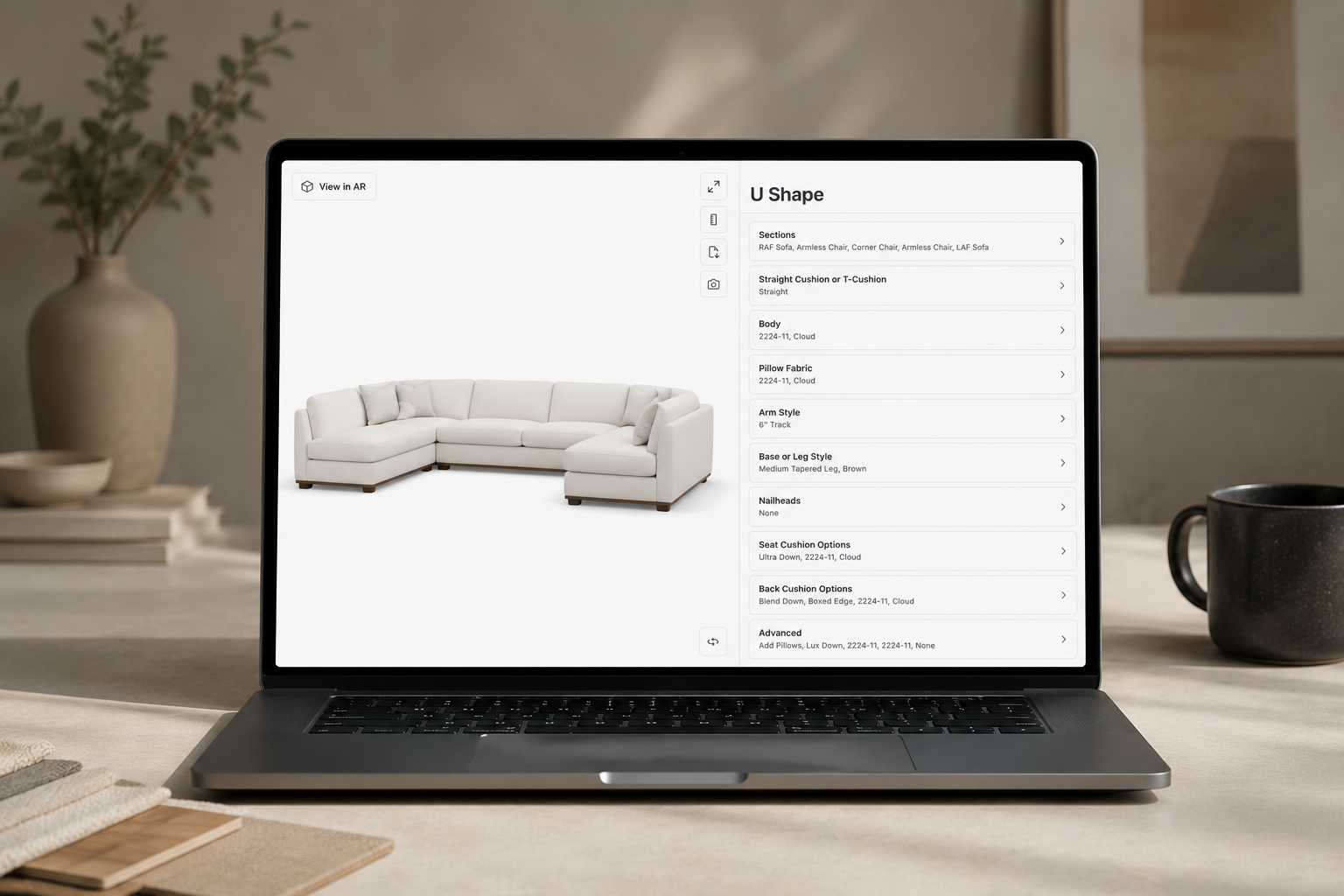
Interactive 3D configuration can then help the customer understand what one of those products actually looks like when it's customized for them.
Discovery and visualization solve different parts of the same problem.
AI can help find the right product.
Visualization can help someone believe it's the right product.
Pricing can't stay disconnected either
Now add one more constraint to our original request:
“…and keep it under $4,000.”
Suddenly product discovery depends on pricing.
For a simple product, that's straightforward.
For configurable furniture, the price may depend on the exact sectional pieces selected, fabric grade, finishes, options and the retailer selling it.
The AI might understand that a collection fits the customer's style, dimensions and performance requirements — but can it know whether the configuration they're building actually fits the budget?
This is where configuration, visualization and pricing increasingly need to work together.
Technologies such as AI-powered CPQ can help turn complex manufacturer pricing into accurate configured quotes, while manufacturers maintain control over retailer programs and pricing structures.
As shopping becomes more conversational, the ability to answer “Can I have this, like this, for this much?” becomes incredibly powerful.
Furniture brands now have two audiences for their product data
For decades, product information was primarily created for people.
Sales representatives.
Retailers.
Designers.
Customers.
Those audiences aren't going away.
But there's now another audience sitting between the brand and the shopper:
machines trying to understand what the brand sells.
Search engines were the beginning of this shift.
AI shopping makes it much more significant.
OpenAI's shopping infrastructure, for example, allows merchants to provide product feeds containing richer, current product information so products can be represented more accurately when shoppers are comparing options in ChatGPT.
That points toward a broader change in commerce.
Product data is no longer simply operational information sitting behind the shopping experience.
It is becoming part of the shopping experience.
So, what happens when ChatGPT starts choosing the sofa?
The answer isn't that AI replaces retailers, designers, showrooms or furniture websites.
Furniture is too visual, personal and considered a purchase for the entire journey to collapse into one chatbot recommendation.
But AI may increasingly influence which products make it into the consideration set in the first place.
And that changes the competition.
The question may no longer be only:
Can customers find your furniture?
It may also be:
Can AI understand it well enough to know when it's exactly what they're looking for?
For furniture brands, preparing for that future isn't simply an SEO exercise.
It means creating a digital foundation where product configuration, materials, dimensions, visualization and pricing aren't isolated pieces of information.
They're connected parts of the product itself.
Because in a world where a shopper can describe exactly what they want and let AI narrow down the options, having the right sofa isn't enough.
AI has to know you have it.

Related posts

Interested in our solutions?