The Furniture Industry’s Scalability Problem
What Manufacturers Told Us About Product Content, Pricing Complexity, and the Future of Digital Commerce
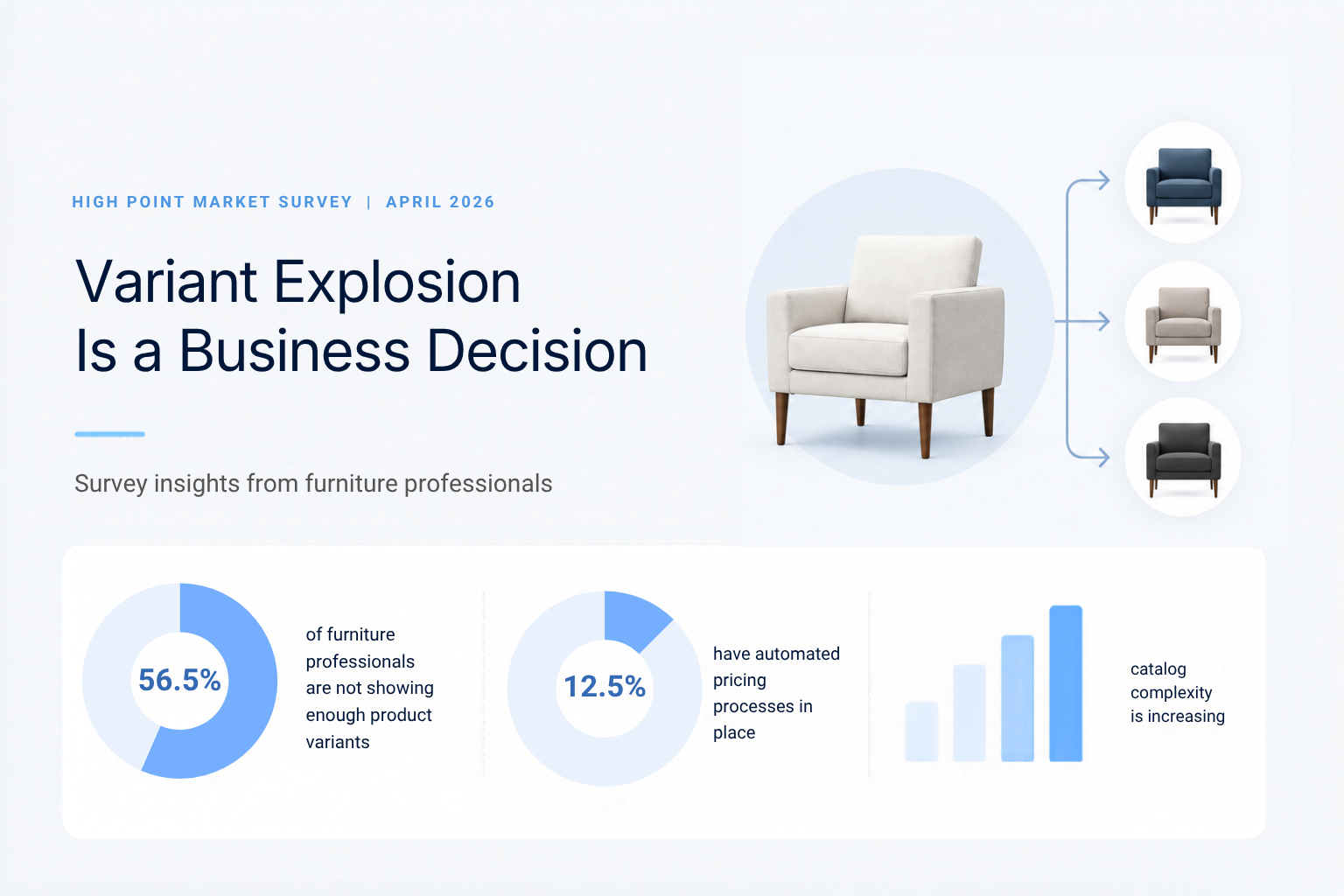
During High Point Market, we surveyed furniture manufacturers and industry professionals to better understand the operational challenges shaping modern furniture commerce. The responses revealed a consistent pattern across the industry: manufacturers are under growing pressure to scale product content, pricing, and customization faster than traditional workflows can realistically support. As catalogs expand and digital expectations rise, many brands are struggling to balance speed, cost, operational complexity, and the demand for premium-quality customer experiences.
The Hidden Revenue Cost of Missing Product Variants
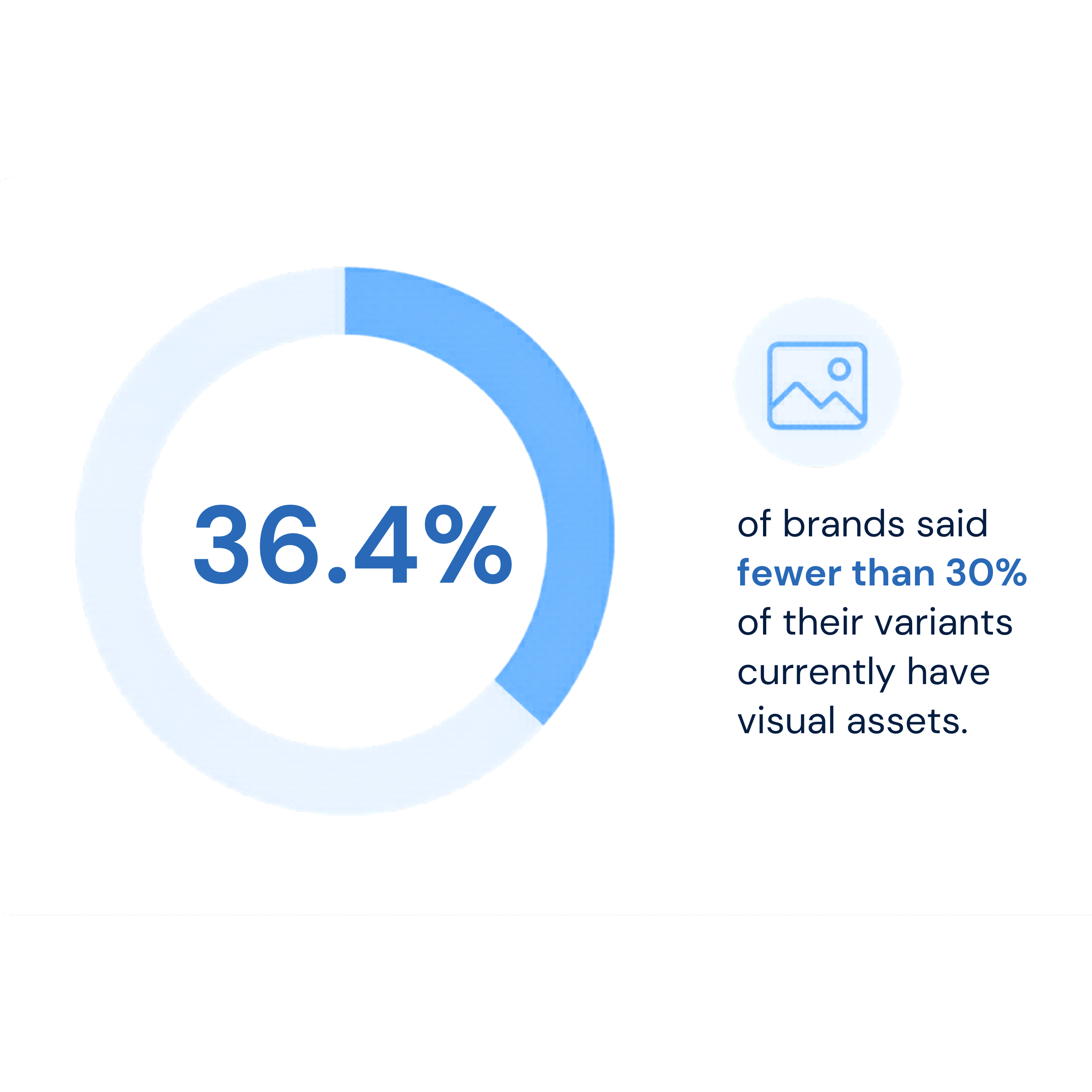
The strongest signal from the survey was the industry’s ongoing struggle with variant coverage. More than half of respondents (56.5%) identified “not enough variants shown” as the biggest gap in their current product content strategy. At the same time, 36.4% reported that fewer than 30% of their product variants currently have visual assets available online.
This is not simply a content limitation. It represents a direct commercial problem with measurable financial consequences.
In a category like furniture, where buying decisions are highly visual and emotionally driven, incomplete product visualization reduces buyer confidence and narrows perceived assortment. If a customer cannot see the exact fabric, finish, configuration, or combination they are considering, hesitation increases dramatically. In many cases, customers either abandon the purchase entirely or settle for a lower-margin alternative that feels safer because it is visible and easier to understand.
For manufacturers with highly configurable products, every missing visualization effectively becomes lost merchandising potential.
The financial impact extends beyond ecommerce conversion alone. Incomplete visualization coverage creates friction across the entire sales process. Sales representatives are forced into manual support roles, retailers require additional assistance, and customers increasingly depend on custom requests, PDFs, tear sheets, or showroom intervention simply to complete the buying journey. Instead of operating as scalable digital commerce systems, many manufacturers remain dependent on labor-intensive selling workflows that increase operational costs while simultaneously slowing down revenue generation.
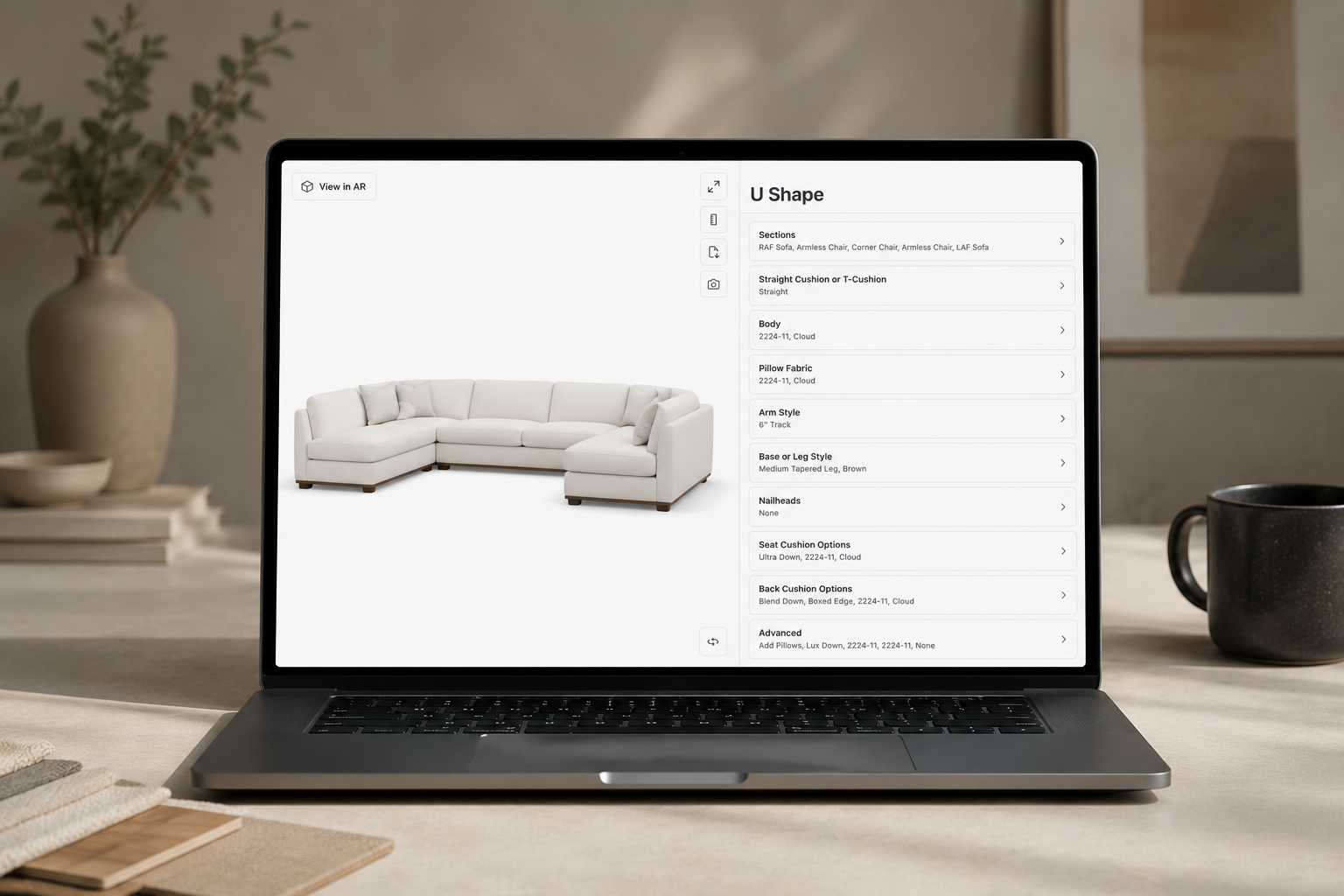
As catalogs continue expanding, this problem compounds rapidly. Every new fabric, finish, sectional layout, or retailer-specific assortment multiplies the number of combinations that need to be commercially supported.
Why Traditional Content Production No Longer Scales
The survey results around production bottlenecks clearly reinforce this reality. When asked about the biggest obstacle preventing product visuals from going live faster, respondents were almost evenly split between cost (44.4%) and speed or production time (40.7%).
This reflects one of the most important tensions currently shaping the furniture industry.
Manufacturers understand they need significantly more content coverage than they have today, but the economics of traditional content creation become increasingly unsustainable as product complexity grows. Photography remains the dominant standard because of its realism and brand consistency, but scaling photography across thousands of product combinations creates exponential increases in production costs, studio coordination, sample management, shipping logistics, editing, approvals, and retailer-specific asset requests.
The result is that many brands are trapped between two equally difficult choices: limit product coverage and sacrifice conversion opportunities, or expand production and absorb rapidly increasing operational costs.
At the same time, manufacturers are unwilling to compromise on quality in exchange for speed alone. Nearly half of respondents (46.4%) identified high-end visuals as their team’s top priority today.
This is a critical insight because it demonstrates that visual quality remains directly tied to perceived brand value in furniture commerce. Unlike lower-consideration retail categories, furniture purchasing decisions depend heavily on trust, material perception, craftsmanship detail, and emotional reassurance. Poor imagery damages confidence immediately, particularly for premium brands operating in higher price brackets.
Manufacturers therefore face a uniquely difficult balancing act:
They need more visuals, they need them faster, they need them at lower operational cost, but they cannot afford to reduce realism or presentation quality in the process.
That tension is becoming one of the defining operational challenges in furniture commerce today.
The Rise of Hybrid Visualization Workflows
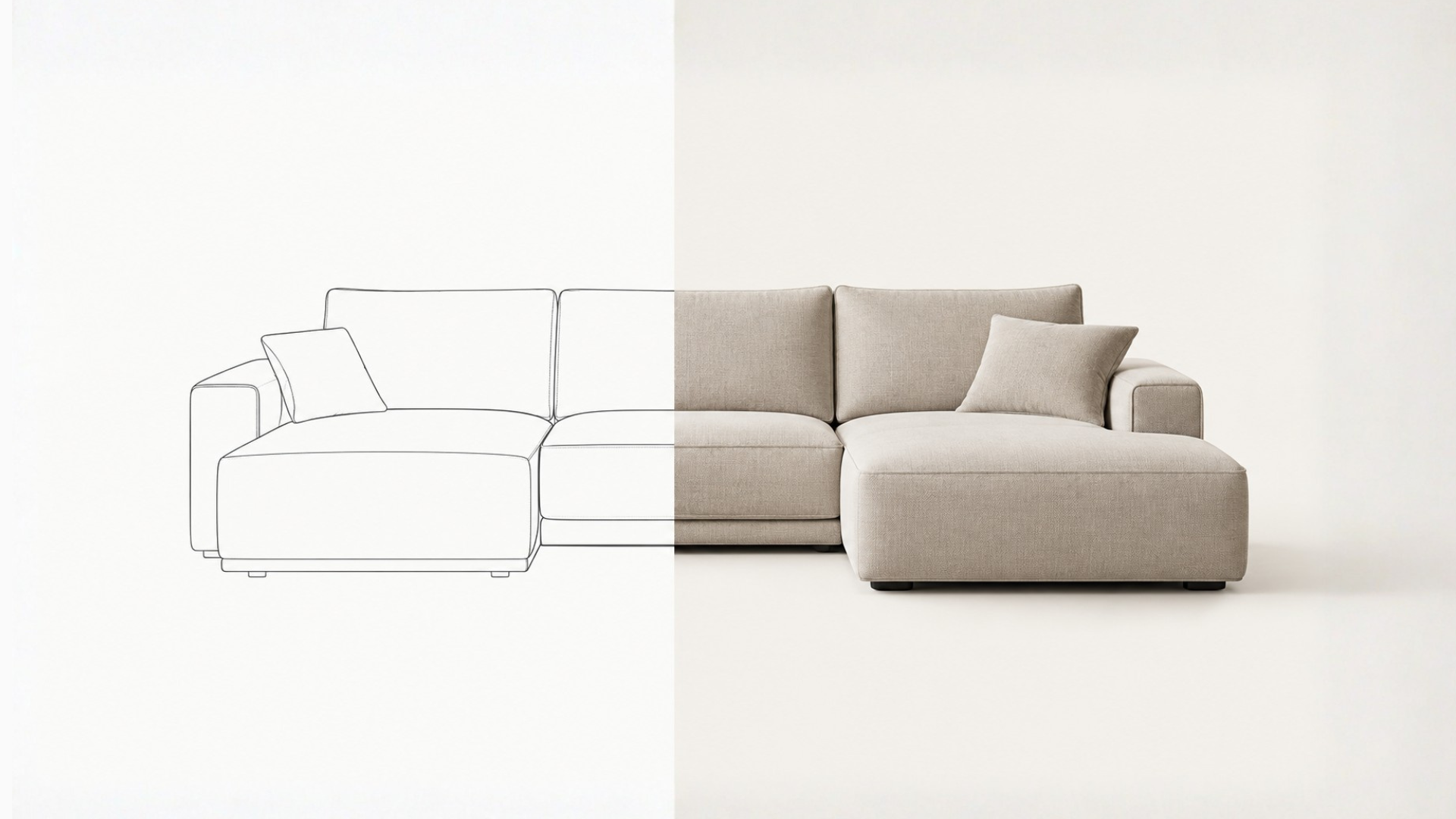
The responses around workflow adoption suggest that many manufacturers are already searching for ways to resolve this problem through hybrid production strategies.
While traditional photography remains the most widely used workflow, many respondents reported combining photography, CGI/3D rendering, and AI-generated imagery together rather than relying on a single production method.
This indicates that the industry is already transitioning toward more scalable visualization ecosystems.
Manufacturers are no longer asking whether alternative production technologies are viable. Instead, they are evaluating how these tools can work together to reduce bottlenecks without sacrificing quality. The shift happening across the industry is not necessarily about replacing photography. It is about creating scalable workflows where photography, 3D assets, AI-generated scenes, and automation each support different stages of the content lifecycle depending on speed, cost, and merchandising requirements.
The most forward-looking manufacturers increasingly recognize that content generation is no longer simply a creative function. It is becoming a core operational capability directly tied to launch speed, assortment visibility, retailer enablement, and overall revenue scalability.
Why Manufacturer Websites Are Becoming the Primary Showroom
The survey also highlights how dramatically digital expectations have shifted over the last several years. An overwhelming 66.7% of respondents said they feel the greatest pressure to maintain complete product visuals on their own website, significantly ahead of retail partners and marketplaces.
This reflects a major transformation in how manufacturers now view their digital presence.
Historically, many brands depended on retailers and physical showrooms to communicate assortment depth and product value. Today, the manufacturer website itself increasingly functions as the first showroom experience. Customers expect complete assortments, configuration flexibility, lifestyle imagery, accurate pricing, and personalized product journeys directly from the brand.
When those experiences fail, the consequences are immediate:
Reduced conversion rates, lower retailer confidence, higher bounce rates, abandoned product journeys, and increased pressure on customer support and sales teams.
Incomplete digital merchandising is no longer simply a marketing weakness. It increasingly impacts revenue performance, operational efficiency, dealer relationships, and long-term brand competitiveness.
Pricing Complexity Is Becoming an Operational Risk
The operational challenges uncovered in the survey extend far beyond visualization into pricing and configuration management as well.
Only 12.5% of respondents reported having a fully automated configuration and pricing system in place today. The vast majority still rely on spreadsheets, partially connected systems, or heavily manual processes to manage pricing logic and product configuration.
In furniture manufacturing, this creates substantial hidden costs because pricing complexity is exceptionally difficult to scale manually. Fabric dependencies, dimensional rules, finish exclusions, retailer-specific markups, freight considerations, COM programs, promotional pricing structures, and regional assortment differences all create layers of operational complexity that generic workflows struggle to manage.
Unsurprisingly, respondents identified “managing complexity” as the single biggest challenge within their configuration and pricing processes.
This complexity creates significant downstream business impact. Slow or disconnected pricing workflows delay quote generation, reduce sales team efficiency, increase the likelihood of pricing errors, complicate retailer onboarding, and extend product launch timelines. As assortments grow, manual systems become increasingly fragile and difficult to maintain.
The issue is no longer whether manufacturers can technically manage these processes internally. The issue is whether they can continue managing them profitably as catalogs, retailer requirements, and customer expectations continue to expand.
The Industry Is Moving Toward Connected Commercial Systems
One of the most insightful observations from the survey came from Marissa Rigatti of John Thomas, who noted:
“Working with a vendor who already has your product information means an AI generated image is proportionate to what you're going for.”
Her comment reflects a larger shift happening across the industry.
Manufacturers are beginning to recognize that scalable content generation is not only about visualization technology itself, but about structured product data and connected systems. The real long-term advantage comes from unified workflows where product data, pricing logic, visualization assets, and configuration rules operate together instead of existing across disconnected departments and manual processes.
This is where the industry appears to be heading: toward centralized product ecosystems where content generation, pricing management, configuration logic, and retailer distribution are no longer fragmented workflows, but interconnected operational systems designed for scale.
Conclusion: A Defining Moment for Furniture Commerce
Manufacturers are no longer dealing with isolated problems around content creation, pricing, or digital merchandising independently. These issues are converging into a larger scalability challenge that impacts nearly every stage of the commercialization process.
The same survey found that only 12.5% of respondents have automated pricing processes in place. As product options continue to multiply, manual workflows become increasingly difficult to maintain. Brands that invest in scalable configuration, visualization, and pricing systems will be better equipped to manage growing product complexity.
Those that continue relying on fragmented workflows and manual processes may increasingly struggle to compete as digital expectations continue accelerating.
The survey results point to a growing operational challenge. As product catalogs become more complex, manufacturers face a choice: build scalable systems that connect product data, visualization, and pricing, or continue absorbing the manual effort required to manage that complexity.
Related posts

Interested in our solutions?