7 AI Trends Furniture Manufacturers Can't Ignore in 2026
Artificial intelligence is moving from experimentation to everyday business. AI is no longer a futuristic concept for furniture manufacturers. Across the industry, it's becoming part of everyday operations, from creating marketing assets and simplifying product configuration to improving pricing accuracy and enhancing customer experiences. As product catalogs continue to grow and customer expectations rise, manufacturers are under increasing pressure to deliver more content, respond to customers faster, and provide engaging digital buying experiences without adding more manual work. The companies gaining a competitive advantage aren't replacing people with AI. They're using it to eliminate repetitive tasks, improve decision-making, and scale operations more efficiently. According to McKinsey's latest State of AI research, AI adoption continues to grow across industries, but relatively few organizations have successfully scaled AI across multiple business functions. The biggest opportunity lies not in simply adopting AI tools, but in integrating them into core business workflows. Here are seven AI trends shaping the furniture industry in 2026 and why they matter.

1. AI-Generated Product Imagery Is Becoming Part of the Standard Workflow
Traditional product photography remains an essential part of furniture marketing, but it's no longer the only way manufacturers create visual content.
Instead of photographing every finish, fabric, or product variation, companies are increasingly combining high-quality 3D product data with AI to generate lifestyle scenes, room settings, and campaign imagery much faster.
This allows marketing teams to produce significantly more visual assets while reducing both production time and photography costs.
Solutions like Intiaro AI Photo Studio help manufacturers transform existing 3D assets into marketing-ready lifestyle imagery, making it easier to launch campaigns, support retailers, and showcase more products across digital channels.
As Marissa Rigatti of John Thomas Furniture explains:
"Working with a vendor who already has your product information means an AI generated image is proportionate to what you're going for."
Her observation highlights an important point: successful AI image generation starts with accurate product data. When AI has access to structured product information and high-quality 3D assets, manufacturers can create visuals that remain true to the product while dramatically increasing content production.
Why it matters: Manufacturers can scale content creation without scaling production costs.
2. AI-Powered CPQ Is Making Complex Pricing Simpler
Furniture pricing has never been simple.
Different fabrics, finishes, dimensions, COM programs, retailer-specific pricing, regional price lists, freight rules, and promotional logic create thousands of possible pricing combinations.
Managing this complexity manually is time-consuming and increases the risk of errors.
AI-powered Configure, Price, Quote (CPQ) solutions are helping manufacturers simplify this process by assisting sales teams with product configuration, pricing recommendations, and quote generation while reducing manual work.
Intiaro AI CPQ combines configurable product rules with AI assistance to help sales representatives configure products faster, generate accurate quotes, and respond to customers with greater confidence.
Our recent High Point Market survey reinforces this challenge: only 12.5% of respondents reported having a fully automated configuration and pricing process, highlighting a significant opportunity for manufacturers looking to modernize their sales operations.
Why it matters: Faster, more accurate quotes shorten sales cycles and create a better buying experience.
3. Structured Product Data Is Becoming More Valuable Than Ever
While AI tools receive most of the attention, structured product data is what makes them effective.
AI performs best when product information is complete, consistent, and connected across systems.
Dimensions, materials, finishes, pricing rules, configuration logic, technical specifications, and product relationships all help AI generate more accurate recommendations, visuals, and responses.
Manufacturers investing in structured product data today are building the foundation for future AI capabilities, from AI-generated marketing content and intelligent product recommendations to automated quoting and AI-powered customer support.
As AI continues to evolve, product data will become one of the most valuable digital assets manufacturers own.
Why it matters: Better data leads to better AI.

4. AI Search Is Changing How Customers Discover Products
The way buyers search for products is changing.
Instead of browsing pages of search results, many customers now ask AI assistants like ChatGPT, Gemini, Claude, or Perplexity to recommend products, compare options, or answer purchasing questions.
This shift means manufacturers need to think beyond traditional SEO.
Detailed product information, structured specifications, informative content, and organized product data all make it easier for AI systems to understand and recommend your products.
Companies that prepare their digital content for AI-powered search today will be better positioned as customer buying behavior continues to evolve.
Why it matters: Visibility increasingly depends on how well AI understands your products - not just how well search engines rank them.
5. AI Is Helping Sales Teams Respond Faster
Sales teams spend a significant amount of time answering repetitive questions, locating specifications, checking product availability, and preparing quotes.
AI can assist by surfacing product information instantly, summarizing technical documentation, recommending product configurations, and supporting customer conversations.
Rather than replacing sales professionals, AI enables them to spend more time building relationships and solving customer problems while routine administrative work becomes faster and more consistent.
Why it matters: Sales teams become more productive without sacrificing customer service.
6. Personalization Is Becoming Easier to Scale
Today's buyers expect personalized experiences.
AI makes it possible to recommend relevant products, suggest compatible finishes, highlight similar collections, and tailor content based on customer preferences or browsing behavior.
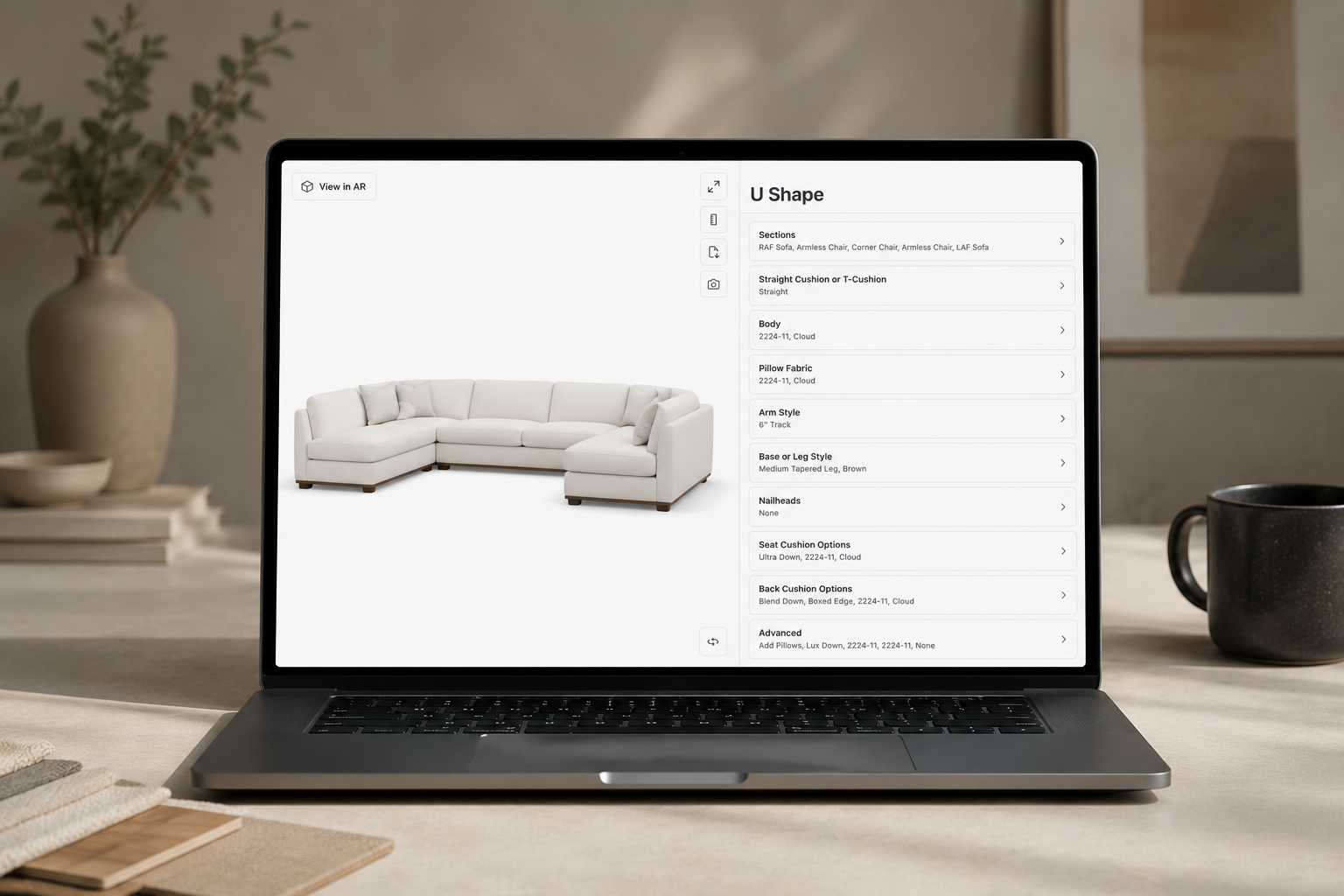
When combined with configurable 3D experiences, AI helps customers navigate large product catalogs more efficiently while discovering products that best match their needs.
For manufacturers offering extensive customization, this creates a more engaging buying journey while reducing friction during product selection.
Why it matters: Better personalization leads to higher engagement and increased buyer confidence.
7. Connected AI Ecosystems Will Create the Biggest Competitive Advantage
Perhaps the most important trend isn't a single AI tool.
It's the move toward connected digital ecosystems.
Visualization, pricing, configuration, product information, marketing assets, ERP systems, and retailer distribution become significantly more powerful when they all operate from the same source of truth.
Rather than managing disconnected workflows across multiple departments, manufacturers are increasingly investing in integrated platforms that connect product data throughout the customer journey.
This connected approach doesn't just improve today's operations, it also makes adopting future AI technologies significantly easier.
As new AI capabilities emerge, companies with connected digital infrastructure will be able to adapt much faster than those relying on fragmented systems.
Why it matters: The strongest competitive advantage won't come from using the most AI tools, it will come from having the best-connected data.
Preparing for the Future of AI in Furniture
Artificial intelligence is rapidly becoming part of the furniture industry's everyday toolkit. While the technology will continue to evolve, the priorities remain the same: better product data, scalable content creation, faster pricing, and more connected customer experiences.
Manufacturers don't need to adopt every new AI solution overnight. The biggest opportunities often come from identifying repetitive, manual processes and finding smarter ways to make them faster, more accurate, and easier to scale.
At Intiaro, we're seeing this transformation firsthand. From creating marketing-ready product imagery with AI Photo Studio to simplifying complex quoting through AI CPQ, manufacturers are already using AI to streamline workflows, improve customer experiences, and support business growth.

Related posts

Interested in our solutions?